I used to be a "three-minute enthusiast for diet tracking."
To lose weight, I downloaded no fewer than seven calorie-tracking apps, and my longest streak lasted 12 days. Eating every day felt like solving a math problem: for a bowl of noodles, I had to search "braised beef noodles, 200g serving"; adding a fried egg meant searching "fried egg, 5g oil"; takeout was even more frustrating—the restaurant's "small portion" never matched the app's "standard serving." In the end, I'd often skip logging after hotpot or a group dinner, give up completely, and delete the app.
Until last month, a friend recommended EtinAI to me, saying, "You just snap a photo and do nothing else." I downloaded it skeptically, and to my surprise, not only did I stick with it, but I gained something more important than losing 5 pounds.
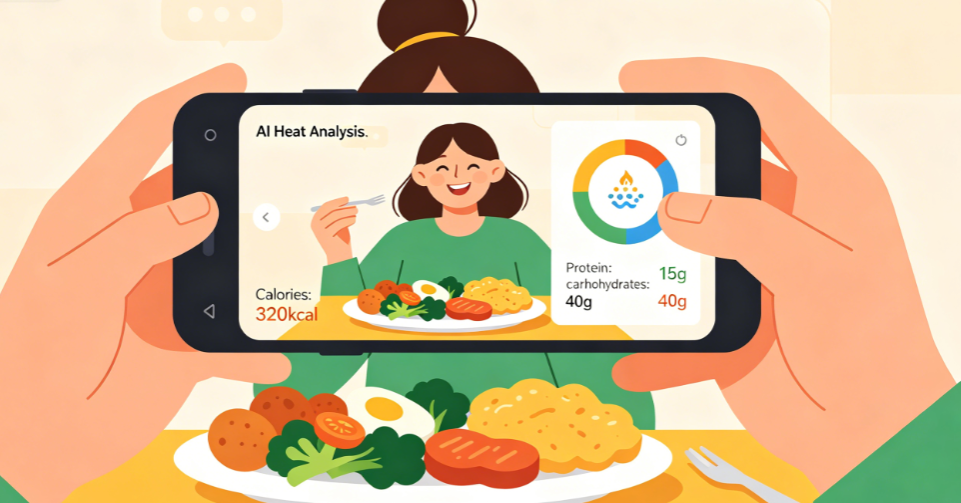
Turns out, diet tracking can be this simple
The first time I opened EtinAI, I felt a bit unaccustomed—no lengthy registration process, no complex forms asking for height, weight, or body fat percentage. With just two taps to log in, I was directly on the photo-taking interface.
In the center of the screen was a small 5×5 cm square frame—this is the most unique feature of EtinAI. My friend told me that as long as I place any object of known size (like an egg, a pork chop, or even a coin) into that frame, the AI can accurately calculate the portion and nutrition of the entire meal.
I snapped a photo of my company cafeteria's one-meat-one-veg combo. Three seconds later.
The results popped up instantly: Rice 120g (144 kcal), Braised pork ribs 85g (213 kcal), Stir-fried broccoli 150g (45 kcal), Protein 23g, Carbs 32g, Fat 11g.
I was truly stunned at that moment. What used to take me 5 minutes to search ingredients, adjust portions, and calculate, was now done with a single lift of my phone.
Later I tried more complex scenarios: takeout malatang, homemade dumplings, even barbecue with friends. As long as I aimed at that 5×5 cm frame and snapped a photo, the AI always accurately identified every ingredient, even counting the sesame seeds sprinkled on top and the sauce poured over. The official site says its recognition accuracy for Indian food is 94.7%, and from my experience, the accuracy for Chinese food is even higher—after all, it's what we eat every day.
I no longer feel guilty about food
In the first week of using EtinAI, I lost 2 pounds. But what truly surprised me wasn't the number on the scale—it was that I finally stopped feeling guilty about food.
Before, I lived in the anxiety of "I'll get fat if I eat this." I'd agonize for half an hour over eating a piece of cake, then blame myself for the rest of the day, and later binge at night, falling into a vicious cycle of "diet – break – get fatter." I classified foods into "good" and "bad," thinking losing weight meant cutting out all "bad foods."
But EtinAI showed me with data that there's no such thing as "absolutely cannot eat."
One afternoon, a colleague gave me a slice of cheesecake. In the past, I would either resist eating it or regret it afterward. But that day, I took out my phone and snapped a photo—it showed 217 kcal. I checked my total calorie intake for the day; I still had over 300 kcal left. So I ate that slice of cake without worry, only needing to skip half a bowl of rice at dinner to balance the day's total.
It turns out losing weight isn't about starving yourself—it's about knowing the numbers. When you clearly know how many calories and nutrients each bite contains, you're no longer driven by vague anxiety. You can calmly eat a slice of cake or drink a bubble tea, as long as you leave room in your daily total.
I started truly "eating well"
After one month of using EtinAI, I lost 5 pounds. But my biggest gain was slowly developing the habit of eating well.
Before, I always wolfed down my food, scrolling through my phone while eating, not even knowing what I had consumed. Now I take a photo before eating; that brief 3 seconds slows me down, and I start to really look at what's on my plate.
I realized I used to eat too many carbs—a full bowl of rice every meal—while being severely lacking in protein. So I gradually adjusted: reducing rice to half a bowl and adding an extra egg or a piece of chicken breast. Without deliberately dieting or eating unpleasant weight-loss meals, just by slightly tweaking my diet composition, my body felt much better. I no longer felt sleepy in the afternoon, and I didn't have trouble sleeping at night from overeating.
More importantly, I no longer see diet tracking as a burden. It's become a natural thing, like picking up chopsticks before a meal. Open the app, snap a photo, 3 seconds done, then put down the phone and truly enjoy your food.
The developers of EtinAI said their goal was to create a tool you can use without having to "persist." I think they succeeded. A truly good tool never adds to your burden; it quietly integrates into your life and helps solve your problems.
Final thoughts
I still use EtinAI every day to record my meals, but I no longer stare at the scale daily. I know that as long as I maintain this eating habit, my weight will naturally drop to a healthy range.
Weight loss was never a short-term sprint; it's a long-term lifestyle. And EtinAI helped me take the easiest first step. It never forced me to starve or exercise; it just made me see clearly what I eat every day.
If you're like me—tried countless diet tracking methods and failed, troubled by food anxiety, or want to lose weight gradually without starving—you might really want to give EtinAI a try.
Basic features are completely free, no ads, no annoying notifications, and all your data belongs solely to you. Available on iOS and Android, with one account syncing across all devices.
Trust me—once you delegate meal photos to AI, what you gain is far more than a decreasing number on the scale. You'll shed anxiety, learn to make peace with food, and gradually become a better version of yourself.
Comments
Leave a Comment