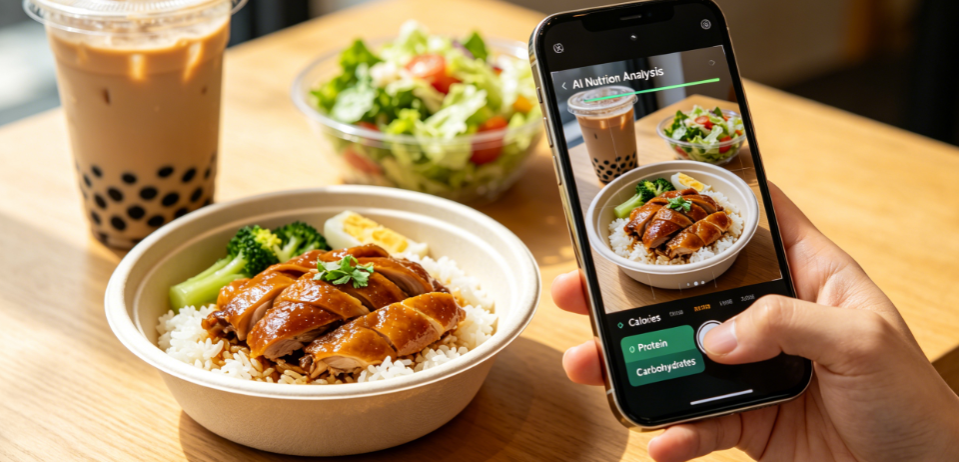
Believe it or not, when I go to the convenience store downstairs to buy lunch, my first reaction upon lifting the lid is not to grab chopsticks, but to pull out my phone and take a photo.
In the past, I would have scoffed at the idea. I always thought that calorie counting via photos was a complete waste of money – if the food was arranged slightly crooked or the angle was off, the result could differ by hundreds of calories. It was useless beyond novelty. I had previously downloaded two similar apps, took a couple of photos, found them inaccurate, and deleted them without a second thought.
Lately, with a tight project deadline, I’ve been relying on convenience store food for all three meals. After half a month, I felt uneasy: I didn’t know how oily the bento was, or whether I had enough protein that day. Trying to manually track calories – searching for ingredients, estimating portions – took five minutes per meal, eating into my lunch break. While browsing my folders, I came across EtinAI, which I had downloaded earlier. With a 'one last try' mindset, I gave it a shot, and this week it has become a regular habit before I eat.
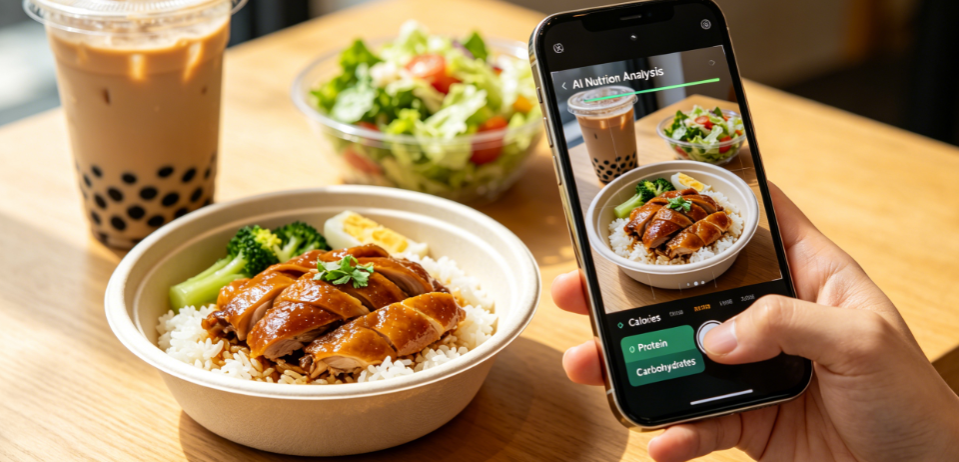
Testing convenience store meals one by one, accuracy was better than I expected
I deliberately picked a few items I often buy, from breakfast to late-night snacks, to see if it could only handle well-plated home-cooked meals.
Breakfast was two vegetable buns + one tea egg + a cup of hot soy milk. The buns were wrinkly, and I thought it wouldn’t recognize them, but I placed the tea egg in the 5×5cm square frame in the center of the screen as a reference, pressed the shutter, and three seconds later the result came out: two buns, one egg, and even the soy milk gave a calorie reference for a standard cup. I later checked against the nutrition label on the packaging, and the error was about 30-40 calories – perfectly acceptable for daily meals.
The lunch bento was the most surprising. One meat and two vegetables, rice at the bottom, dishes on top, all mixed together. The photo actually separated the chicken leg, cabbage, wood ear mushrooms, and carrot dices, and estimated the rice portion quite accurately. I always thought the rice in a bento wasn’t much, but seeing the data, rice alone accounted for nearly half the calories. The next day, I quietly asked the staff to give me less rice.
The oden I bought for a late-night work snack fell into the 'usable but not that accurate' category. The skewers themselves – radish, seaweed, fish balls, konjac knots – were mostly recognized; but the broth’s calories couldn’t be calculated, only the ingredients themselves. I thought that was fair – after all, no one drinks all the oden broth, so knowing the ingredients’ calories is enough.
What keeps it on my phone isn’t accuracy
Seriously, there are more precise tools – a food scale measures to the gram, 100% accurate. But why can’t most people stick with them? Because it’s too much trouble.
EtinAI’s greatest strength has never been how accurately it calculates, but how it has lowered the barrier to 'recording' to almost nothing. Open the app and you’re straight at the camera interface – no need to fill out pages of personal info, no need to set daily calorie goals, and even the onboarding guide is just a single line of small text. Lift the lid, snap a photo, put the phone away – the whole process takes five seconds, and your food won’t even get cold.
Even rarer is that it doesn’t tie you down. No check-in reminders, no consecutive day leaderboards, no 'today’s completion' progress bar. If you remember to snap today, fine; if you forget, no big deal. It won’t chase you with notifications, and it won’t make you feel guilty like 'I missed recording again, might as well give up.'
With other apps I used before, missing a meal would cause anxiety for ages, and I’d end up uninstalling them. Using this one, I went out for a weekend dinner with friends and didn’t open it all day; when I came back, I could pick it right up again. Things without pressure are easier to stick with.
There’s another detail I really like: in nearly two weeks of use, I haven’t seen a single pop-up ad. Even the membership entry is buried deep in the settings, and the core features – photo recognition, diet logging, nutrition viewing – are all free. It just sits quietly in your phone; use it when you want, and it never forces itself on you. Such restraint is really rare nowadays.
To be honest, don’t expect it to work in these scenarios
Of course, it’s not all-powerful, and I need to be clear about the pitfalls.
Snacks and drinks in sealed packaging definitely can’t be recognized through the box or bag – you have to open and pour them out. If that’s too much trouble, don’t bother.
Porridge that’s overcooked, thick soups, stews – ingredients are all mixed together; it can only calculate total calories, not break down the portions of each ingredient. If you’re after precision, you’ll be disappointed.
Also, large dishes for a gathering of a dozen people – a big plate of fish, a huge hotpot – with no reference for portion size, the error will be much larger than for single-person meals. It can only serve as a rough reference.
Simply put, it’s a tool for everyday use by ordinary people, not a professional-grade precision instrument. If you’re prepping for a bodybuilding competition and need accuracy down to every gram of nutrition, it definitely won’t suffice – stick with a food scale.
To end with something honest
I now see it as a 'little meal advisor'.
I don’t expect to lose much weight with it, nor do I force myself to photograph every meal. I just snap a quick photo when eating convenience store food or ordering takeout, to get a rough idea: if I know I had too much oil today, I’ll choose something lighter tomorrow; if protein is low, I’ll add an egg in the afternoon. No deliberate dieting, no battling with numbers – before I knew it, I’ve adjusted my diet to something much more comfortable.
It’s not a magic weight-loss tool, nor does it have any earth-shattering technology. But it lets you, in your busiest days, take a little care of your diet without much effort. For ordinary people, that’s enough.
If you also eat takeout or convenience store food every day, find manual calorie tracking too troublesome, yet want some peace of mind, you really should give it a try. The basic features are free anyway, and if it doesn’t work out, deleting it is no loss.
Comments
Leave a Comment