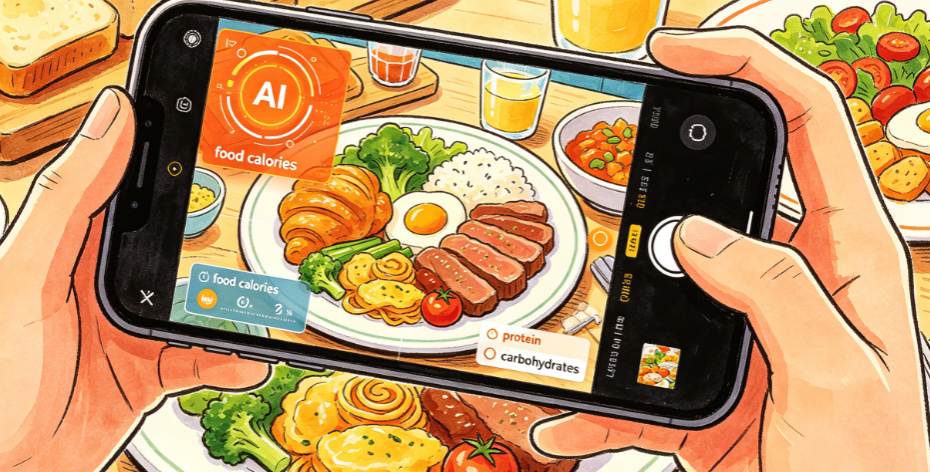
It's a bit funny to say, but I used to get torn whenever my friends invited me out to eat on weekends.
I truly wanted to go and eat, but after coming home I would always fret: How many calories did I consume in this meal? Did all my efforts this week go to waste? The more I thought about it, the guiltier I felt, so I'd punish myself by fasting for the next two days, only to end up starving at midnight and binge-eating again, falling into a vicious cycle.
Recently, I had another brunch date, and I casually brought EtinAI along. I went in with a "just taking pictures for fun, it's not accurate anyway" mindset, but after these few times of taking photos of eating out, it didn't help me lose weight, but it first cured my post-meal guilt.
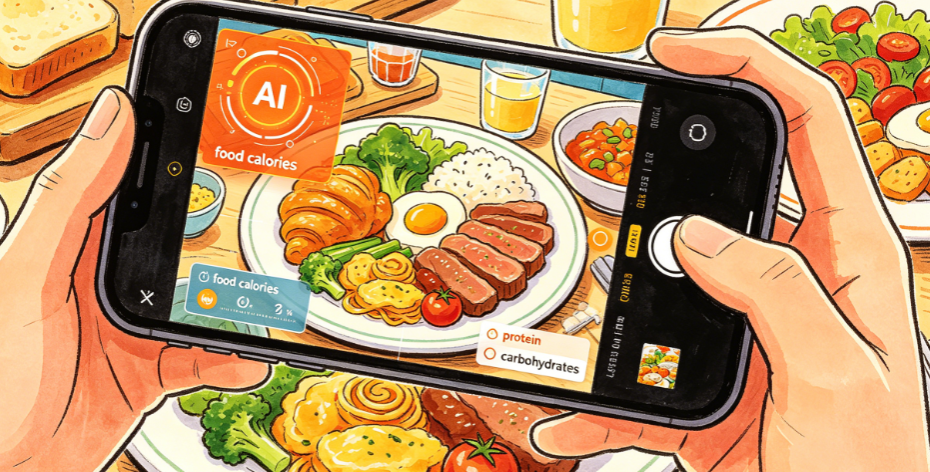
Three common eating-out scenarios, I photographed each one
During this period, I indulged with friends, from brunch to hotpot to dessert shops, and casually photographed everything. There were pleasant surprises and some expected disappointments.
The first was a weekend brunch staple. I ordered eggs Benedict with roasted potato wedges, and my friend got a Caesar salad. The plating was neat; I placed a fork next to it as a reference and took a photo. I thought it would be quite accurate, but the hollandaise sauce on the eggs Benedict wasn't separated out and was included in the total calories. The potato wedges, lettuce, bacon, etc., were clearly distinguished, and the total calories differed from my previously checked reference by less than 100 kcal. For eating out, I think that's sufficient, because there's no standard for how much sauce the kitchen adds anyway.
The second was Chongqing hotpot, which I had the least expectations for. A whole table of ingredients boiled in spicy broth, greasy when scooped out—who could tell them apart? But I took a chopsticksful of food and placed it in a bowl to photograph, and it actually identified tripe, duck intestines, potatoes, and lotus root slices. Of course, the oil from the broth couldn't be accounted for, only the calories of the ingredients themselves, but I was already satisfied—at least I knew roughly how much I ate, without always thinking, "I ate hotpot so I definitely gained three pounds."
The third was a slice of cake for afternoon tea. This falls into the "can give a rough reference" level. It recognized it as mousse cake and gave a typical calorie range for a slice, but it couldn't distinguish whether it was mango or chocolate flavored, or how much cream there was. Still, it's better than my previous guessing, where I'd think a piece of cake had 1,000 kcal and be too scared to eat it, when it was actually only around 300—an occasional slice is nothing.
More important than precision is having a clear idea
The biggest pitfall I used to fall into was "eating out = calorie explosion = all efforts wasted."
After a meal, I'd feel heavy-hearted, thinking I had poor self-control, so I'd just give up and indulge in snacks and milk tea at home, ending up consuming even more unnecessary calories.
After using it a few times, I actually became more relaxed. It turns out a normal brunch is only about 600 kcal, not the thousands I imagined; hotpot, as long as you don't drink the oily broth, with more veggies and meat, isn't that terrifying in calories; a slice of cake as afternoon tea can be balanced out by eating less carbs at dinner—no need for guilt at all.
It's like giving you a vague but reliable yardstick. No need for precision to the gram, no need to obsess over details; as long as you know "roughly how much you ate this meal," you feel at ease. You won't be anxious about the unknown, nor will you binge because of guilt.
And the best part: my friends found it novel when they saw me taking photos and asked what it was. I demonstrated it to them, and a group of us took turns photographing the dishes, having a blast without any awkward "Why are you taking photos of your food? That's so pretentious" moments.
Of course, there are also quite disappointing aspects, to be honest
There are quite a few limitations when eating out, not comparable to cooking at home.
For example, in dimly lit restaurants, the recognition speed is much slower, sometimes you have to hold up your phone to find the light source, which looks a bit silly. Also, for large shared dishes like grilled fish or big plate chicken, if you can't separate them into your own bowl, the error can be quite large, and you can only get a rough idea.
Also, for fusion dishes with very complex preparations, thick sauces obscuring the ingredients, recognition accuracy suffers.
But I think it's all acceptable. After all, eating out can never be precise; even if you bring a food scale to the restaurant, you can't know how much oil and sugar the kitchen used. Having a roughly accurate reference to help you get rid of the anxiety that "eating = gaining weight" is already worth the price.
As for ads and fees, it's the same as before: all daily-use features are free, no pop-ups or ads, and the membership entry is hidden so deep it's impossible to find. It quietly serves as a tool without seeking attention — that really wins people over.
Finally, a heartfelt word
I used to think that managing your diet meant being meticulous, precise with every meal, and eating out was a violation.
Now I realize that for ordinary people, eating isn't so black and white. Group meals, afternoon tea, occasional cravings — these are all part of life. No need to make a big deal out of a single meal.
To me, EtinAI has never been some weight loss miracle; it's more like a little helper to ease anxiety. It doesn't judge whether you ate too much or too little, it doesn't give you a score; it just quietly tells you a rough number.
Once you know, you have a clear idea; having a clear idea, you stop being anxious; without anxiety, it's easier to maintain a good state.
If you also often feel guilty about eating out and can't stop blaming yourself after a meal, you should really give it a try. Don't go in with any utilitarian purpose; just treat it as a reference for your diet, and you'll feel much more relaxed.
Comments
Leave a Comment