I’m not afraid to admit that before this, my impression of “diet management” was simply this: complicated.
Words like calories, basal metabolic rate, and macronutrients made my head spin; watching bloggers share their fat-loss meal formulas—protein, carbs, and fat all proportioned out—just got my brain tied in knots trying to calculate. I tried following the trend twice before, but couldn’t stick with it past three days. I always felt, “If I can’t even understand this stuff, there’s no way I’ll succeed,” so I gave up and just ate whatever I wanted.
I thought I’d never get into diet management, until recently when I stumbled upon EtinAI and saw people saying, “Just snap a photo, you don’t need to know anything.” I downloaded it with the mindset of “if it’s no good, I’ll delete it in a couple of days.” But to my surprise, this simple little app actually got me through a whole month without me having to memorize a single piece of knowledge. Instead, it slowly helped me understand the ins and outs of eating.
No need to study first—just open it and start. Truly zero barrier to entry.
The biggest reason I gave up before was the high barrier.
With other diet apps, just opening them requires filling in a ton of info for over ten minutes: height, weight, age, body fat. Then they calculate your basal metabolic rate and daily expenditure, and immediately set a bunch of goals that leave my eyes glazed over. Before I even start logging, I’m already put off by a bunch of jargon—how am I supposed to keep going when I don’t even know what TDEE is?
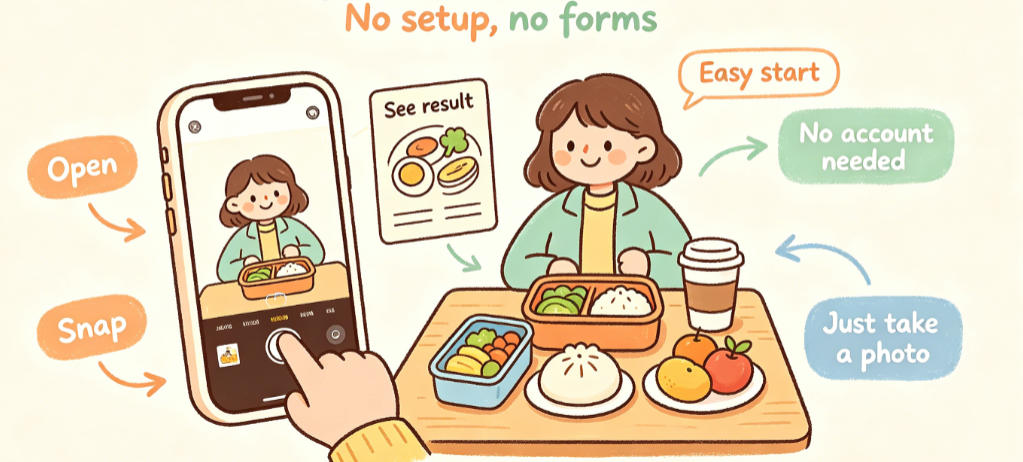
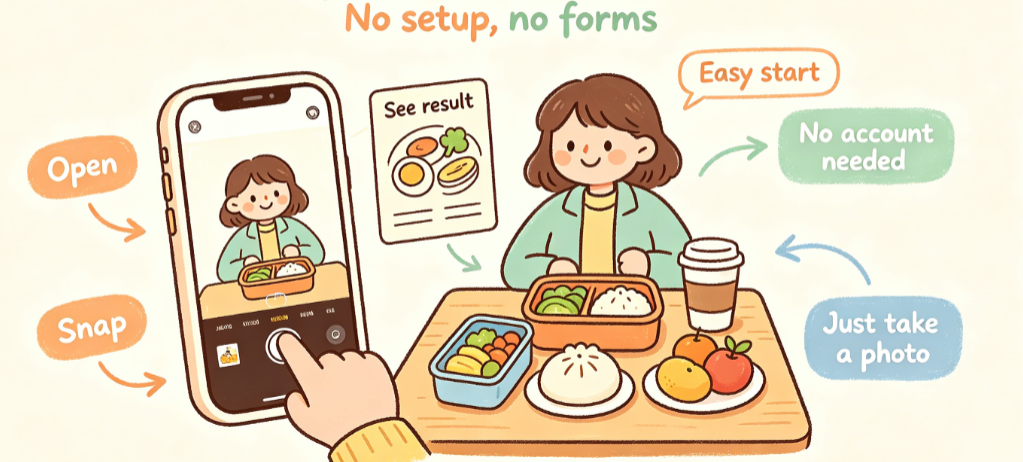
EtinAI is nothing like that. You don’t even need to register an account or fill in any personal details. Just open it and you’re immediately at the camera interface. Point it at your food, snap a picture, and in two seconds you get the results. No manually selecting ingredients, no estimating weights, not even a single word to type.
When I first started, I couldn’t even tell you what the three macronutrients were, but it didn’t hinder my use at all. The results clearly list calories, protein, carbs, and fat. If you don’t understand, no worries—just jot it down. There’s no pressure like “if you don’t get it, you can’t use it well,” and no newbie tutorials quizzing you on facts. It’s truly zero barrier to entry.
No need to change your diet right away—just logging is a win.
I used to think that starting diet management meant immediately breaking bad habits, eating salad for every meal, and strictly counting calories. Every time I’d start with great ambition, only to give up after two or three days and blame myself for lacking willpower.
Using EtinAI, I realized there’s no need to force yourself from the get-go. For the first two weeks, I didn’t change a thing—still ordered takeout, still had bubble tea. I just snapped a photo after eating.
No calorie red lines, no daily goals, no warnings popping up because you ate something fried. I simply used it as an electronic food diary—just record it, and whether to change or not was entirely up to me.
With such low demands, this was actually the first time I managed to keep a food log for over a week. Turns out it wasn’t that I lacked perseverance—it’s that I had set the bar too high for myself. Building the habit of logging is far more important than pursuing a “healthy diet” from the very start.
You just get it as you use it—no need to memorize facts.
After casually snapping photos for two weeks, without deliberately learning anything, I gradually started to develop a sense of it.
For foods I often ate, like braised chicken with rice or convenience store buns and soy milk, after snapping them two or three times, I naturally got a rough idea of their calories and carb ratios. Before, when someone said, “This dish is high in calories,” I never really felt it. Now, after logging a few times myself, I can roughly gauge the level at a glance.
Even the three macronutrients I used to struggle with became clear over time: chicken legs and eggs are high in protein, rice and noodles are all carbs, and fried items or saucy dishes tend to be high in fat. Without deliberately memorizing definitions, just glancing at my own logs every day quietly taught me.
Turns out you don’t need to “learn first and then start”—once you start using it, the knowledge naturally sinks in.
A few common concerns from newbies, straight up.
A lot of nutrition novices around me have asked me questions, so let me be straightforward.
First: If I know absolutely nothing about nutrition, can I understand the data?
Absolutely. At the very beginning, you can just look at the calorie number and ignore everything else. Just knowing roughly how much you eat in one meal and how much you consume in a day is enough. The rest—protein, carbs—you’ll gradually pick up by seeing them often. No need to force yourself to understand everything at once.
Second: Do I need to get a membership from the start?
Honestly, no. The free version’s photo recognition and data on calories and the three macronutrients are more than enough for a beginner. Once you’ve used it for a while and feel you need more detailed micronutrient info or data export features, then consider upgrading to a membership. For newbies, buying a membership right away is likely a waste of money.
Third: With such simple features, could it be ineffective?
On the contrary, I think for beginners, “being able to stick with it” is ten thousand times more important than “having all the features.” No matter how professional an app is or how accurate its data, if you find it annoying and delete it after two days, it’s completely useless. Starting with the simplest approach and forming the habit of logging is the biggest benefit.
Finally, let me be real.
I used to think that diet management was a very professional thing—something only people who understand nutrition and have strong discipline can do. Now I realize it doesn’t have to be that complicated at all.
You don’t have to pursue perfection from the start, you don’t have to memorize all the facts first, and you don’t have to set a bunch of rules right away. Find a handy tool, start by snapping a casual photo, and take it slow.
If you’re also a complete nutrition novice who wants to keep a little eye on your diet but is afraid of complexity, afraid you won’t learn, or afraid you can’t keep it up, give EtinAI a try. No barriers, no pressure. As you use it, you’ll naturally figure out the whole eating thing.
Comments
Leave a Comment